Home / Partner Picks / Circle

Best for: Online Community Platform
Last updated: September 13, 2026
If you want the best-looking, most capable community platform for creators, Circle is it — discussions, courses, live streams, events, memberships and payments in one branded home, with a polish nothing else in the category matches. The honest part is the money. The cheap $39 Basic plan is gone, entry now starts at $89/mo, Circle takes a cut of every sale on top of Stripe, and the features people actually want — automation, API, removing Circle's branding — live on the $199 plan. It's excellent. It's just not cheap, and the sticker price isn't the real price.
Circle began life as a clean discussion tool and has grown into the most complete community platform aimed at creators and brands. Everything lives in one branded home: threaded discussion Spaces, native courses with drip scheduling, Live Rooms and streamed events, member directories, and payments through Stripe or PayPal. The design is the headline — it looks and feels like a modern SaaS product rather than a bolted-together forum, and that polish is a big part of why creators pick it over cheaper rivals. Unlimited members on every tier, including the entry plan, means growth never triggers a surprise per-seat bill.
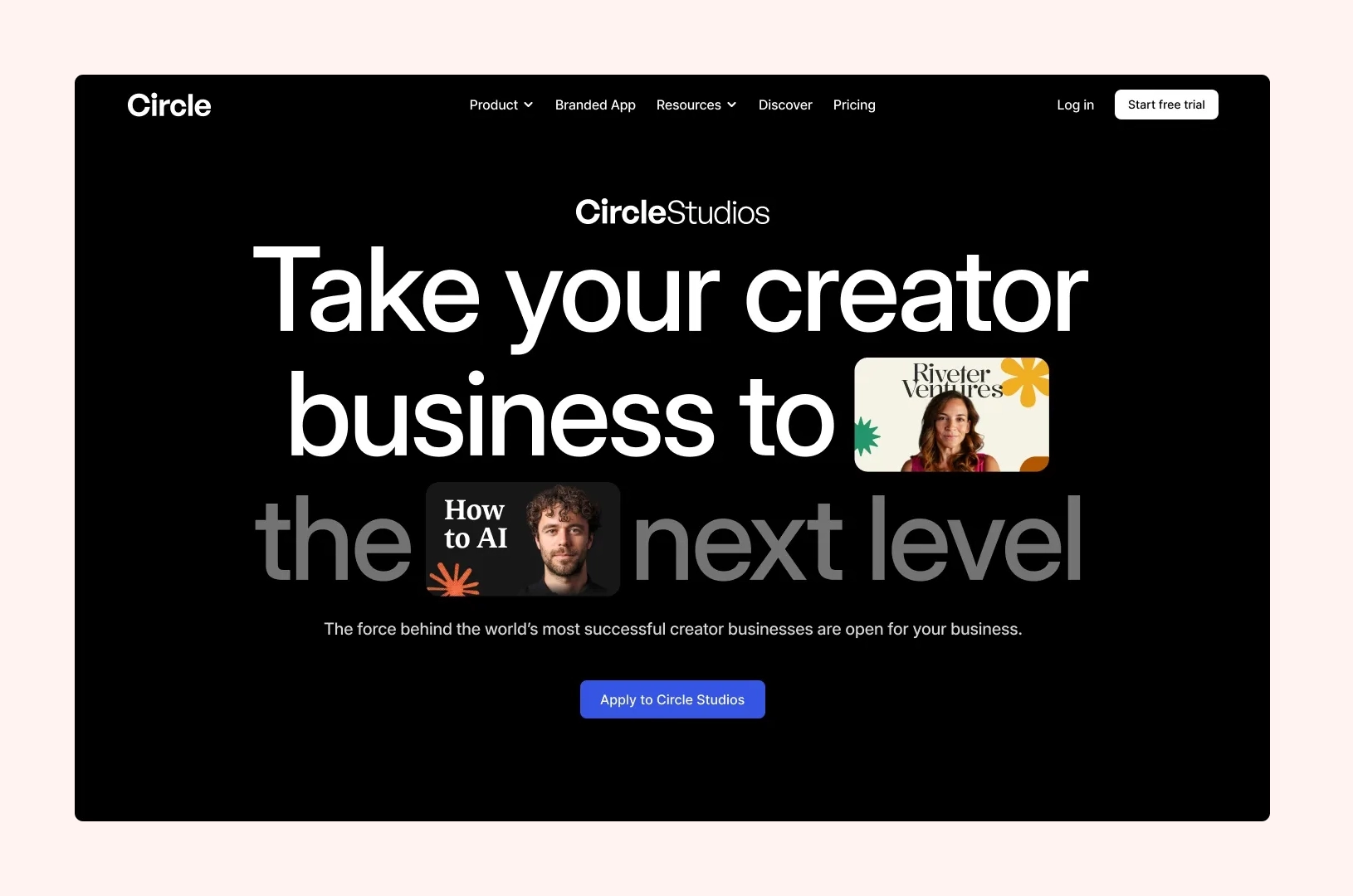
The all-in-one claim mostly holds up. You can host a cohort course, run a weekly live call, sell a paid membership and keep every conversation in the same place, without stitching together separate course, chat and video tools. Courses support video, downloads, quizzes and completion tracking; Live Rooms handle everything from small mastermind calls to broadcast-style events. For a solo creator or a lean team, consolidating three or four subscriptions into one platform is the real value — even before you weigh the design polish on top.

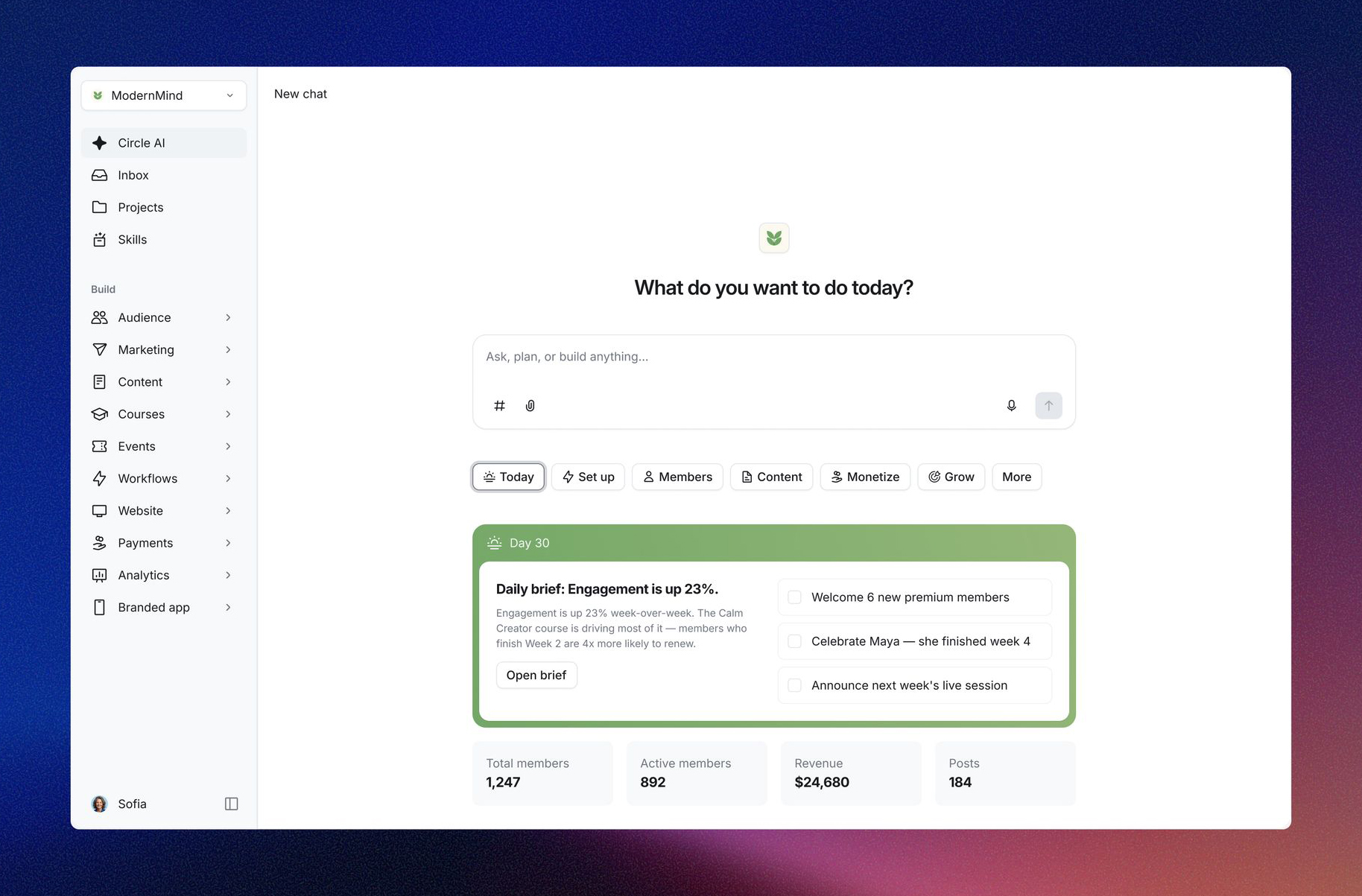
In 2026 Circle repositioned itself as “AI-native,” and it is more than a marketing line. Co-Pilot drafts and analyses content, AI Agents field member questions and flag people who have gone quiet, and Activity Scores quantify engagement so automations can act before members drift away. Used well, this is a genuine operating layer for a community team of one. The catch is familiar: the most capable pieces — Content Co-Pilot, Activity Scores and the fully autonomous Agents — sit on the Business plan and above, so the AI story and the pricing story are tightly linked.
This is where honesty matters. The advertised $89 Professional plan is the floor, not the ceiling. Circle adds a platform fee on every sale — 2% on Professional, 1% on Business — stacked on top of Stripe's roughly 2.9% + 30¢, so combined fees can approach 5% before you count the subscription. Email Hub, Circle's email-marketing add-on, is billed separately from around $99/mo by contact count. Add a couple of extras and a “$89” community routinely runs $200–300 a month in practice. None of this makes Circle a bad deal; it makes it a premium one that rewards communities already earning real revenue.
Circle is the category's best-designed, most feature-complete option, and its AI tooling is now genuinely ahead of most rivals. It is not the budget choice, and it no longer pretends to be. If you're validating an idea, start somewhere cheaper like Skool; if you're ready to invest in a polished, scalable home for a paying community, Circle earns its price — provided you budget for the plan, the fees and the add-ons you will actually switch on.
Circle spent 2026 rebuilding itself around AI. At Circle Eclipse in June it relaunched as an "AI-native" platform, and the pitch is that you can describe the community you want in plain English while the AI does the heavy lifting — building spaces, configuring paywalls and seeding starter content — so you direct a vision instead of clicking through settings. In day-to-day use the AI shows up in four distinct places, and it's genuinely one of the most complete AI toolsets in the category.
The first is Co-Pilot, a writing and marketing assistant that drafts posts, course outlines and emails, and — in its Marketing Copilot form — watches your community around the clock, surfaces the trends and themes worth acting on, and suggests confident calls on pricing, offers and each member's next step. The second is AI Agents: member-facing bots embedded in Spaces that handle onboarding, answer questions from content you've trained them on, and nudge quiet members, plus admin-side agents that can pull community-health signals, member lists, silent-member detection and content ideas — with any write or delete action kept behind an approval gate. The third is Activity Scores, which rate every member 1–10 over a rolling 30-day window across signals like presence, contribution, participation and connection, so a behavior-triggered workflow can automatically fire a DM or re-invite the moment someone goes cold. The fourth is AI Workflows, which wire those scores and events into automated actions across your community.
The honest caveat — consistent with everything else about Circle's pricing — is that the good stuff is gated. A basic Co-Pilot is available across plans, but Content Co-Pilot, transcriptions and Activity Scores require the $199 Business plan, and the fully autonomous AI Agents and Workflows sit on the custom-priced Plus and Enterprise tiers. The AI is real and genuinely useful; it's also another reason the sticker price and the real price drift apart.
STARTS AT
$89 – $419/mo
Three public plans plus a custom tier, cheapest annually: Professional $89/mo, Business $199/mo, Enterprise ~$419/mo, and Circle Plus custom (branded apps). The old Basic plan ($39–49) was discontinued in 2024, so the entry floor is now $89 — a real jump if you remember Circle as a budget option.
Yes — the cost most people miss. On top of Stripe/PayPal (~2.9% + 30¢), Circle takes its own cut: 2% on Professional, 1% on Business, 0.5% on Circle Plus. A membership on Professional can pay close to 5% combined before the subscription. At higher revenue, Business's lower fee starts paying for the pricier plan.
Automation and control. Professional ($89) covers core community, courses, events and memberships — but no workflows, no API, no white-label, 2% fee. Business ($199) adds workflows, API, branding removal, more seats/spaces/storage, and halves the fee to 1%. Want built-in automation or branding removal? You're on Business; there's no middle option.
Higher than the headline. The big add-on is Email Hub (email marketing), priced by contacts from ~$99/mo. Add transaction fees and extras like branded sender emails, and a $89 Professional plan commonly lands at $200–300/mo in real use. Budget plan + fees + the add-ons you'll actually switch on.
Different philosophies. Skool is minimal and cheaper — one low-cost plan, simple, gamified — great for validating a community before people have paid. Circle is the premium option: far more customisation, native courses and events, automation, branded apps, at a higher price. Validate on Skool; move to Circle for polish, depth and scale.
No free plan, but every tier has a 14-day trial (no card) plus a 30-day money-back guarantee. With no permanent free option and an $89 floor, the trial is your real chance to confirm fit — set up a genuine test community during it rather than just clicking around.
THE LAB REPORT
Be an early subscriber. No spam, unsubscribe anytime.